Artificial Intelligence

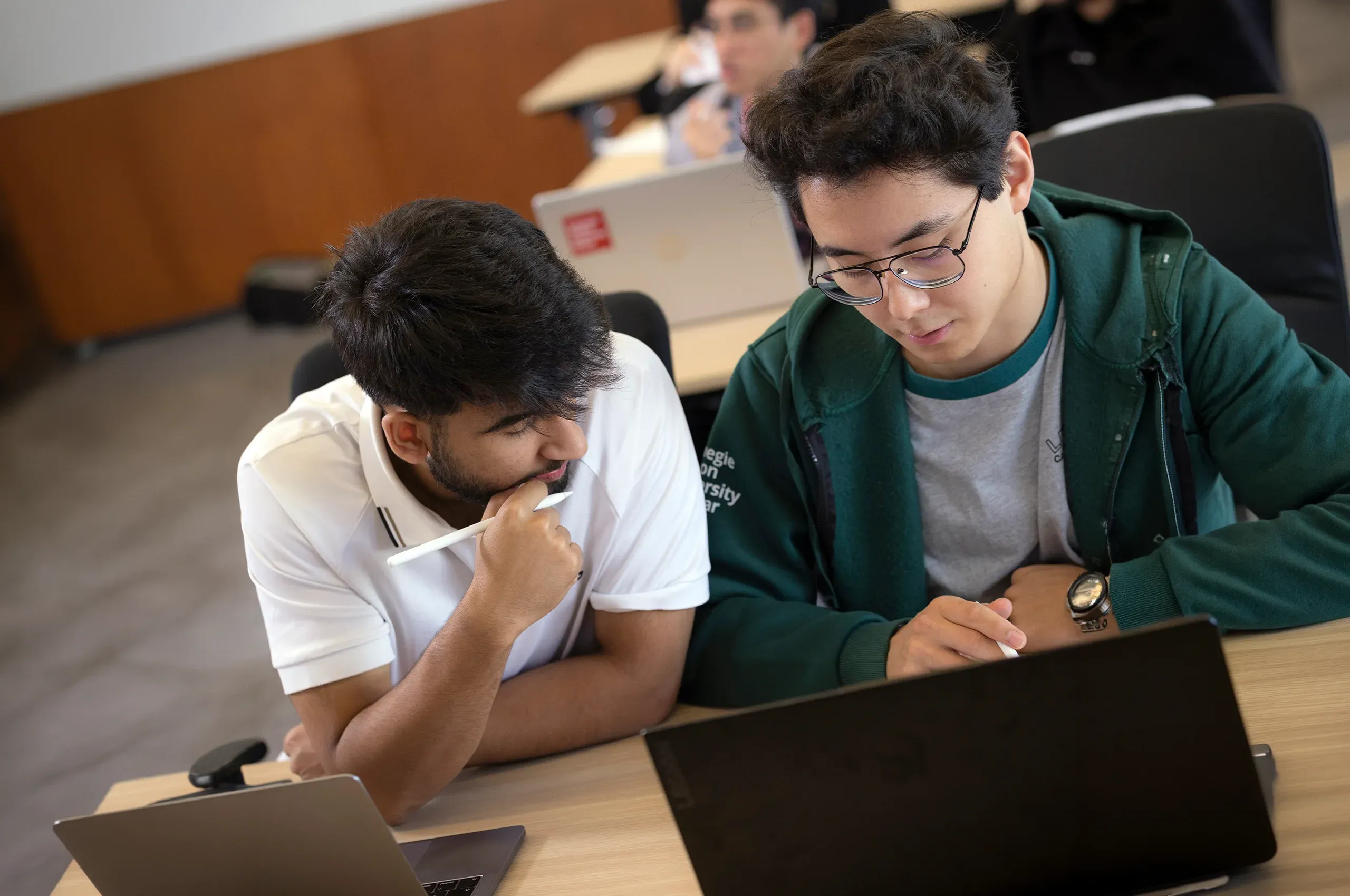
Carnegie Mellon has led the world in artificial intelligence education and innovation since the field was created. CMU’s undergraduate Artificial Intelligence program was the first of its kind in the United States, and is the first Bachelor of Science in Artificial Intelligence offered in Qatar.

Bachelor of Science in Artificial Intelligence

Artificial Intelligence at Carnegie Mellon

Introduced at Carnegie Mellon’s Pittsburgh campus in 2018, and at the Qatar campus in 2025, the Bachelor of Science in Artificial Intelligence (BSAI) program provides students with the expertise in machine learning and automated reasoning to build the AI of tomorrow.

Artificial intelligence represents a broad and dynamic field, and at Carnegie Mellon University, we embrace our role in shaping its future. We offer a broad and deep curriculum that reflects the impact of AI on careers and the skills needed to thrive in a tech economy.

Artificial Intelligence students have identical graduation requirements as students at Carnegie Mellon in Pittsburgh. Graduates have CMU degrees, conferred from the U.S. campus.

How to apply to AI or CS

Applying to AI or CS

Students who would like to study Artificial Intelligence or Computer Science apply to a common Computing at CMU-Q year without declaring a major. At the end of the first academic year, Computing at CMU-Q students will declare a major of either AI or CS.

Learn more about applying to AI or CS

Program at a Glance

The AI program gives students the in-depth knowledge to transform large amounts of data into actionable decisions. The curriculum focuses on how complex inputs — such as vision, language and huge databases — can be used to make decisions or enhance human capabilities.

The Artificial Intelligence program at CMU-Q includes:

  • AI core and electives
  • Mathematics and statistics core
  • Computer science core
  • University core courses in general education
  • Ethics elective

Students at CMU-Q have many opportunities to engage in research, including a senior thesis project, independent study, or internships with a CMU-Q research group.

Program at a Glance

Degree Program Details

Curriculum

The Bachelor of Science degree in Artificial Intelligence includes coursework in computer science, math, statistics, computational modeling, machine learning and symbolic computation. Because Carnegie Mellon is devoted to AI for social good, students also take courses in ethics and social responsibility, with the option to participate in independent study projects in areas like healthcare, transportation and education.

As students progress through the BSAI program, they develop critical thinking skills with respect to AI methods and applications. They learn to evaluate when and why to use each method, to propose modifications, and to build the AI of tomorrow.

College Honors

College Honors offers an opportunity for students to conduct an independent project and to prepare a formal thesis. College Honors is excellent preparation for graduate studies.

Artificial Intelligence degree breakdown

  • Standard completion time: 4 Years
  • Minimum units required for degree: 360 units
    • Mathematics: 71
    • Computer science: 60
    • Artificial Intelligence: 70
    • Computer science electives: 18
    • Ethics: 9
    • Science and Engineering: 36
    • Humanities and Arts: 63
    • First Year Seminar and Core@CM: 6
    • Free Electives: 27

See the CMU Undergraduate Catalog for more information about the requirements for a Bachelor of Science degree in Artificial Intelligence.

Learn more about the courses at CMU.

Areas of Study in Artificial Intelligence

CMU-Q first-year students in both the Artificial Intelligence program and the Computer Science program start with the same core computing background. Students in the BSAI program then focus their studies in several key areas.

Artificial intelligence core

Explore how machines can learn, reason, and make decisions using techniques like machine learning and large language models (LLMs).

Decision making and robotics

Design and program intelligent machines that sense, move, and interact with their environment autonomously.

Machine learning

Learn techniques that cover areas like deep learning, large-scale data analysis, generative AI, Bayesian methods, and optimization.

Perception and language cluster

Delve into how AI systems interpret and process sensory information, including search, speech, and computational approaches to vision and photography.

Human-computer interaction

Design and evaluate AI tools that are intuitive, effective, and centered around user needs and experiences.

Ethics

Examine the societal impacts, moral considerations, and policy challenges presented by artificial intelligence.


Projects and Research

Research at Carnegie Mellon

At Carnegie Mellon, our mission is to investigate questions that will have a real impact on the world.

As our undergraduates engage in research, we encourage them to think about the question, “why does this research matter?” This is a hallmark of Carnegie Mellon’s approach.

Students in every major can engage in faculty-guided projects in their early years and pursue independent studies and senior thesis projects as they gain knowledge and experience.

What kind of projects do CMU-Q students do?

Students in the Artificial Intelligence program put their knowledge into practice through in-depth projects and research. This experience enhances learning and encourages creative problem-solving.

This is a small sample of course projects that CMU-Q students have worked on:

  • Hail to the Text: Transferring Political Styles for Enhanced Speech Generation
  • Enhancing Disordered Speech from Children Using Generative Adversarial Network and Speech Impairment Severity
  • Efficient Pre-training Techniques for Speech and Audio Large Language Models
  • Deep Learning in 3D: Enhancing Point Cloud Data for Real-World Applications

The Educational Experience

Career Pathways

Graduates find work as artificial intelligence (AI) engineers, machine learning specialists, data scientists, cybersecurity engineers, roboticists or developers in areas like FinTech and business intelligence. They can also work in emerging fields such as language technology, computational biology, human-computer interaction and robotics.

World map showing locations where Carnegie Mellon University in Qatar Computer Science alumni live and work, with the largest represented concentration in Qatar.

Qatar

  • 1001 AI Machine Learning Lead
  • Avey Senior Artificial Intelligence Engineer
  • Cisco Software Consulting Engineer
  • Dolphin Energy Business Solutions Specialist
  • EY Manager
  • Microsoft Cloud and AI Specialist
  • Northwestern University in Qatar Systems Administrator
  • Qatar Airways Cargo Business Intelligence and Analytics Manager
  • Qatar Chemical Company Business Analyst
  • Qatar Computing Research Institute Senior Software Engineer
  • Qatar University Assistant Professor
  • QNB Group Senior Associate, Sustainability
  • Snoonu Technical Lead
  • UBS Qatar Full Stack Engineer

International

Abu Dhabi

  • Abu Dhabi TAMM Technical Advisor

Berlin

  • JustEatTakeaway.com Senior Team Lead

Cambridge

  • Massachusetts Institute of Technology (MIT) Assistant Professor

Copenhagen

  • Uber Software Engineer II

London

  • Databricks Senior Solutions Architect
  • Google Associate Product Manager
  • King’s College London Postdoctoral Researcher
  • NVIDIA Senior Compiler Engineer

Los Angeles

  • Google Software Engineer

New York

  • Bloomberg LP Senior Software Engineer
  • Meta Software Engineer, Machine Learning

Pittsburgh

  • Stack AV Senior Staff Software Engineer
  • Google Software Engineer

Rochester

  • Mayo Clinic Software Engineer/Data Analyst

San Francisco and Bay Area

  • Amazon Applied Scientist II
  • Cosmic Ventures CEO
  • Cruise Senior Deep Learning Optimization Engineer
  • Google Software Engineer
  • Microsoft Principal Product Manager — Viva Engage
  • Samsung Ads Machine Learning Engineer
  • Stealth Startup Chief AI Officer
  • Stellic Co-Founder, CEO
  • Uber Senior Software Engineer

Vancouver

  • Activision Senior Data Scientist

Further studies

Computer Science grads have furthered their studies at elite institutions, including:

  • Cardiff University
  • Carnegie Mellon University
  • Eötvös Loránd University
  • ETH Zurich
  • Georgia Institute of Technology
  • Hamad Bin Khalifa University
  • Harvard University
  • Princeton University
  • Stanford University
  • Technical University Munich
  • University College London
  • University of California Los Angeles
  • University of Michigan
  • University of Oxford
  • University of Pittsburgh
  • University of Technology Sydney

Career Pathways

Graduates find work as artificial intelligence (AI) engineers, machine learning specialists, data scientists, cybersecurity engineers, roboticists or developers in areas like FinTech and business intelligence.

They can also work in emerging fields such as language technology, computational biology, human-computer interaction and robotics.

Meet the Faculty

Faculty members include experts in artificial intelligence, cloud computing, computational morphology, cybersecurity, database management systems, mobile and pervasive computing, natural language processing, parallel computer architectures, and wireless embedded systems.

Mohammed Yusuf Ansari

Postdoctoral Fellow, Computer Science

[email protected]

Gianni Di Caro

Teaching Professor, Computer Science

[email protected]

Eduardo Feo Flushing

Assistant Teaching Professor, Computer Science

[email protected]

Hend Gedawy

Lecturer, Computer Science

[email protected]

Mohammad Hammoud

Associate Teaching Professor, Computer Science

[email protected]

Khaled Harras

Senior Associate Dean, Faculty / Director, HBJ Center for CS Education / Teaching Professor, Computer Science

[email protected]

Christos Kapoutsis

Associate Area Head, Computer Science / Associate Teaching Professor, Computer Science

[email protected]

Amy Melniczuk

Assistant Teaching Professor, Computer Science

[email protected]

Giselle Reis

Associate Teaching Professor, Computer Science

[email protected]

Ryan Riley

Area Head, Computer Science / Associate Teaching Professor, Computer Science

[email protected]

Mohammad Salameh

Assistant Teaching Professor, Computer Science

[email protected]

Bilal Taha

Assistant Teaching Professor, Computer Science

[email protected]

Zikai Zhang

Postdoctoral Fellow, Computer Science

[email protected]